What’s the best pacing strategy for my upcoming marathon?

When it comes to running a marathon, there are three pacing strategy options: Positive pacing, negative pacing, or even pacing.

The most desired pacing strategy amongst most marathon runners is the negative split, or a negative pacing strategy. This means a runner will begin the race at a pace slightly slower than their average marathon pace, and get faster as the race goes on — ideally, finishing the second half of the race faster than the first. Scoring negative splits is a difficult feat because it means having enough gas in the tank in the second half of the race to run faster and stronger than you did in the first. With so many variables that can affect your race — from fueling, to weather conditions, to mental stamina — it’s not guaranteed that you’ll be able to kick things into a higher gear after 13-plus miles on your feet.

Even splits, or an even pacing strategy, means that runners stay pretty consistent throughout the entire race, aiming to run each mile at the same pace, or within 10 to 15 seconds of the previous mile. Like negative splits, this “metronome” pacing strategy can be incredibly difficult to pull off, and requires laser-like focus along with a high level of endurance.

Positive pacing, or positive splits, is often perceived as the less desirable of all the pacing strategies. Positive splits are the opposite of negative splits, meaning runners get slower throughout the race, with the second half of the race being slower than the first. This racing strategy is often attributed to a poor pacing strategy overall, with runners starting the race at a faster pace than they can sustain, and slowing down as the race goes on. Many runners “hit the wall” after mile 18 or 20, and struggle through the last 10k of the marathon, citing everything from gastrointestinal issues, muscle spasms and soreness, mental fatigue and exhaustion as the culprit that sabotaged their race.

Despite positive perceptions about negative-splitting a marathon, and negative perceptions towards positive splits, research shows that for most runners, the best marathon pacing strategy for a goal of a faster race time is to run even splits, or a slightly-positive split race. Recent world records have indicated more even splits are the best race strategy, while other race analyses have found marathoners more often adopt a positive pacing strategy. 

The latter might seem counterintuitive. After all, how can slowing down over the marathon distance lead to a personal record (PR) or personal best (PB)? 

Of course, with most things, there are a couple big caveats.

1. While slightly positive splits may lead to a faster finish time, that doesn’t mean going all-out in the first half of the race and completely falling apart in the second. A 2014 study of New York City Marathon finishers found that while a “positive pace profile” led to faster times in general, the variability in speed was low — meaning that while runners ran a technically slower back half of the marathon, their mile splits didn’t fluctuate a ton throughout the race.

2. Outsiders often associate “positive splits” with bonking, or an athlete’s body shutting down physically or mentally somewhere in the last half, or more often last 10k, of a race. Rather, the pacing strategy of elite marathoners is to start faster than their average pace, and then “recover” in the later stages of the race by running slightly slower than their average pace for two-thirds of the distance. So while they’re technically accumulating positive splits, this tactic isn’t happening because of an unplanned depletion of energy, but as a method of self and energy preservation. 

3. Every race course has a different elevation profile, and this will definitely affect runners’ pacing tactics, as well as their pacing strategies. Strategically difficult courses like the Boston Marathon and New York City Marathon are likely more easy targets for positively-paced races, while net downhill courses will make it easier to accomplish consistent negative splits. 

Whatever race you’re signed up for, no matter your pacing goals, these three takeaways will help you run a faster race:

  1. Train with your pacing strategy in mind — if your goal is to have evenly-paced splits or negative splits, your workouts and training need to reflect that.
  2. Stay consistent — the less variability you have in your pacing strategy, the better control you’ll have over your time goal.
  3. Prepare for both physical and mental hurdles: Runners are often derailed from their pacing strategies and time goals (AKA, they “hit the wall”) due to gastrointestinal distress, fueling issues, and mental barriers. Keep these outliers in mind throughout your training and develop a solid plan in place to ensure they won’t sabotage your race day pacing strategy. 
Fueling for the marathon: How much and how often should you eat during a race?

If you’ve ever had an otherwise-perfect race, long run, or workout ruined due to GI distress or an uncomfortable stomach, you know how important it is to nail your race-day nutrition.

While it’s perfectly normal to be unsure about nutrition, fueling, and marathon training, the right nutrition strategy on race day can really make a difference. A 2023 study analyzing fueling strategies for runners found that per each additional 100-calorie gel consumed, runners were able to run 0.5 to 0.7 kilometers further in the same amount of time. This amounted to a 7.75% increase in speed compared to runners who did not take nutrition. 

Here’s what the science has to say about marathon training and fueling:

  • Carbohydrates: When it comes to carbs, the length of your activity will dictate how much you should be ingesting. For events lasting less than 60 minutes, don’t worry about taking in extra carbs. However, for activities that last between 1 and 2.5 hours, 30-60 grams of carbs per hour is recommended, ideally consumed every 10-15 minutes in a 6-8% carb solution (like in a sports drink). For events longer than 2.5 hours, 60-70 grams per hour (and up to 90 grams per hour!) are recommended. 

While the above research is particular, it’s important to remember that every body is different. Instead of every 10-15 minutes, your body may appreciate 20, 30, or 40 minute intervals. Instead of a carb solution, like a sports drink, you may rather eat gels, chews, or even solid food. 

There’s lots of advice on the internet and from influencers on TikTok and Instagram, but marathon nutrition is very personal. Beyond running a lot of miles during training, it pays to pay attention to what you eat both before, during, and after your run. 

In general:

  • Eat or ingest something before you feel hungry during a race or long run. If you wait until you’re hungry, it’s probably too late! 
  • Experiment with different gels and electrolyte drinks in the early months/weeks of training, and figure out what you like best. 
  • Once you’ve found the nutrition that works best for you, use ONLY that nutrition during the remainder of your training. This will ensure you don’t have any surprises on race day. 
  • Plan your pre-run meals ahead of time (this goes for dinner the night before AND breakfast/whatever you eat before a run). Pay attention to how this sits in your stomach, and increase or decrease portions accordingly. 
  • Within your training log, add a tab for notes regarding fuel and hydration. Write down your fueling strategy, and how you felt during and at the end of your run. If you’re taking in gels every 30 minutes and feel depleted towards the end of your long run, try increasing the intervals at which you take in nutrition. While the study above does indicate you should be consuming gels every 10-15 minutes, this is an important parameter to personalize as well.
  • Pay attention to caffeine content within gels, GUs, and gummies. It’s okay to take in a little bit of caffeine, but monitor how much, and how it affects your performance. 

There’s no one-size-fits-all model for fueling, but the above advice should get you to the starting line. Experiment and figure out the best strategy for you — you’ll thank yourself on race day!

Hopping May Be The Secret To Unlocking A New PR: Here’s Why 

One exercise I’ve been frequently adding to the end of my running clients’ strength and cross training training circuits is hopping. While it may seem a little silly to bop up and down after a series of heavy-weight deadlifts, I have my reasons. The act of running is actually a series of one-legged hops, done repeatedly over and over again — so if hopping is uncomfortable or difficult for someone, it may be a sign that they are not quite ready to run (and they’re definitely not ready to up their mileage or intensity). I also think it’s a good exercise to increase power, practice adequate shock absorption, and provide an alternative calf workout to the much-loved heel raise.

Hopping exercise may also directly translate to improved running economy, according to a new study  published in Scientific Reports. The randomized controlled trial investigated how five minutes of daily double-leg hopping exercises affected running economy in 34 amateur runners over six weeks. Loading was progressively increased by increasing hopping bouts by increments of 10, and decreasing rest time in between sets.

After six weeks, researchers noticed significant improvements in runners running at faster speeds (12 km/hr and 14 km/hour, which roughly translates to 7.6 and 8.6 miles per hour, or paces faster than an 8-minute mile). 

This study’s main takeaway was that short daily bouts–about 5 minutes–of hopping exercises can improve running economy in amateur runners.

To incorporate this into your own training, try this simple exercise:

  1. First, try balancing on your right leg for 30 seconds, and then your left. Pay special attention to any differences you may feel between the two.
  2. Next, jump up and down using both legs 10 times: Do not aim to jump incredibly high, instead, aim to land softly and have your feet work in sync.

If you feel any loss of balance or difficulty during those two quick exercises, it may be a sign to build up your strength, particularly in your glutes, hamstrings, quadriceps, and calves. If you feel anything else suspect–like leakage–it may be time to schedule a visit with a pelvic floor physical therapist. 

If both of those exercises feel good, you can move on to:

  1. 10 x 10 bouts of double leg hops, with 10 seconds rest in between each set. Ending your strength training circuits or warming up for your runs with 10 x 10 bouts of double leg hops is a great place to start: As you get more comfortable and stronger, you can increase the number of sets, the number of hops in each set, the direction of hops (forward and back vs. side to side), the height of each hop (progressing to a tuck jump),  and eventually move on to single leg hops (5 x 10 bouts single leg hops with 10 seconds rest in between, and progress from there). 

Adding daily hops to your routine is a great example of a simple daily activity that can increase your running economy without reinventing the wheel.

Give it a try, and let me know how it goes!

Should You Invest in Super Shoes?

No, you’re not imagining things. 

Professional runners left and right are shattering records, well, left and right.

Most recently, Ethiopia’s Gudaf Tsegay demolished the women’s 5000-meter world record, running a speedy 14:00.21 at the Diamond League Prefontaine Classic.

The question on everyone’s minds is, ‘Are super shoes — the carbon-plated footwear promising big gains and energy return — behind all these faster times?’

If you ask Nike, the answer would be yes. The brand touted their much-sensationalized Nike Vaporfly 4% as shoes that could improve running economy by 4 percent on average in 2017.  Their Next Percent promised even greater benefits, and super shoe production hasn’t slowed down since.

While Nike did their own research to back up their claims, more recent research shows that super shoes may not be all foam and faster times. And for upwards of $250 per pair, you should probably know what you’re getting into before you invest.

Here are 3 recent studies on super shoes so you can make an informed decision before you buy.

1. The benefits of super shoes may not translate to recreational runners

While initial studies found that carbon-plated shoes improve running economy in elite athletes, more recent studies have found that improvements may not translate to recreational runners running at a less aggressive pace. A 2023 study published in the The International Journal of Sports Physiology and Performance (IJSPP) found that subjects running at slower speeds improve their running economy by just a fraction compared to faster athletes.

In this particular study, 16 runners ran at speeds of roughly 9:40 mile pace and 8:03 mile pace in both Nike Zoom Vaporfly Next % 2 shoes, and a control pair of shoes that did not have a carbon-fiber plate. Runners who ran at 9:40 pace in super shoes improved their running economy by .9 percent on average. However, at 8:03-mile pace, their running economy improved 1.6 percent. TL;DR? The slower you run, the less benefits these shoes may have to offer. Read the full study here.

2. Super shoes may make you more susceptible to stress fractures.

A 2023 opinion article published in Sports Medicine featuring five separate case studies warns that runners wearing carbon-plated footwear may be at increased risk for bone stress injuries due to the alterations in biomechanics and cadence that occur due to the shoe. In this particular investigation, runners using carbon-plated footwear had decreased cadence and longer steps, as well as a longer flight time, increasing the force exerted on the foot with every step. Additionally, peak vertical ground reaction forces and vertical impulse step were higher in runners using carbon-plated footwear, further increasing stress and loading on one’s joints. Authors of this investigation warn runners who want to wear super shoes to start wearing them gradually (first every other day, or only for shorter runs) to avoid injury. A second study published in the Journal of Biomechanics found that thicker carbon-plates (3mm) placed just above the outsole of the shoe (or “low-loaded” plates) may decrease the amount of metatarsal stress and help reduce injury risk. While more studies definitely need to happen before we can definitively say anything, it’s definitely important to factor in before purchasing your first pair.

3. “Nothing new on race day” still prevails

While some runners habitually run in super shoes, others sport them briefly on special occasions — like race day or during a time trial, with hopes of improving performance. A recent pilot study found that super shoes may not have the same power as caffeinated GU at mile 18 of your marathon — in fact, they could be doing the opposite. This particular study compared fitness between runners wearing racing flats and those wearing super shoes, and found that while both groups improved running economy over the 8-week intervention period, the group wearing racing flats improved more. Authors of the study hypothesize that participants will improve running economy most efficiently when wearing the shoe they typically train in due to biomechanical adaptations that need to happen when training in a new shoe. While more studies are needed to fully investigate this, the moral of the story is: If you only wear super shoes on race day for a speed boost, you might not be fully repeating the benefits because your body hasn’t adapted to how they affect the way you run. 

    Curious about super shoes? Check out the full studies for more information.

    Running On Your Period? 3 Takeaways for Balancing Your Menstrual Cycle with Your Marathon Preparation

    The other day I got a panicked text from one of my athletes. Her period tracking app had just informed her that her period was set to begin on the DAY of her first marathon. As someone who experiences cramps, bloating and gastrointestinal distress leading up to and during the first 48 hours of her period, she was worried about how it would impact her first-ever marathon. 

    “What advice do you have for running on your period?” she asked. 

    While I’ve spent time figuring out how to navigate my own menstrual cycle and distance running, I know that everyone who menstruates experiences their own signs and symptoms that may not be applicable to the next person. So I decided to look into the research available on menstruation and marathon performance, as well as poll my trusted running community via Twitter and Instagram. 


    When it comes to running on your period, here are the three biggest takeaways I discovered throughout my search. 

    1. Getting Your Period During A Marathon Might Actually Help You Perform Better

    There’s limited research surrounding the topic of female marathon performance and menstruation. However, there is evidence to suggest that running on your period may actually improve your performance. 

    A 2021 study published in the International Journal of Sports Physiology and Performance administered a survey questionnaire to recreational, non-elite runners who had completed multiple marathons within the past 18 months. Of the 185 women found eligible for the study, a total of 106 had their best marathon performance in the luteal phase of their menstrual cycle, when female sex steroid hormones estrogen and progestin are high. Seventy-nine had their best performance during the follicular phase, when estrogen and progestin are low. 

    For those unfamiliar, the luteal phase begins right after ovulation and lasts about 14 days, ending just before a menstrual period occurs. The follicular phase, or the phase in which your body prepares to release an egg, begins after the luteal phase (days 14 through 21) and starts on the first day of menstruation. Therefore, the study’s results found that women are more likely to perform better either just before, or actually during, their period.

    Why does this happen? Well, research shows that female sex steroid hormones (SSH) are more than just reproductive hormones. They also affect metabolism, bone health, respiration, muscle function, thermoregulation, and fluid balance. Compared to exercise, elevations in the SSH during the menstrual cycle at ovulation and during the luteal phase cause lower blood lactate responses, increased fat oxidation, and reduced glycogen utilization during exercises. All of these physiological effects can potentially be advantageous for exercise performance — particularly for endurance activities, like running a marathon.

    While it’s important to recognize that this is an observational study — AKA it is based on reports from individuals themselves and not performed inside a lab — other research and anecdotal evidence confirms this phenomenon. Stacy Sim’s book ROAR, includes both anecdotal and research-backed evidence of athletes experiencing peak performance during their cycle.

    2. You Can Incorporate Your Menstrual Cycle Into Training

    Just because research suggests you may perform better when on your period, doesn’t mean your cramps, gastrointestinal issues, bloat and other symptoms associated with your period won’t get in the way of, or affect, your goal race. While research suggests exercise during your period may actually reduce symptoms like cramps, that may not hold true for everyone. Additionally, heavy menstrual bleeding (HMB) during your period can potentially put you at risk for low iron levels, which can cause fatigue, anxiety, reduced mood and energy levels, certainly affecting your ability to perform. 

    That’s why it’s important to incorporate your menstrual cycle into your training. Log the start and end of your period into your training log, as well as any associated symptoms that accompany it. This way, you can track what helps relieve your symptoms (Midol, increased hydration, iron supplements, specialized nutrition) and have a better knowledge of what to expect if, in fact, your period does arrive the week of your race.

    It’s also important to log a long run and a hard tempo interval (or speedwork) while on your period. Knowing how your body reacts to stress from your period can help you adequately prepare and push through difficult moments during the race.

    3. There Are Other Ways to Prepare

    Just about every runner who menstruates has experienced their period on a run, so fortunately there is a lot of anecdotal evidence about what works for different runners. Suggestions include taking Midol, investing in period panties (Thinx even makes a special ‘sporty’ period panty) or a diva cup, opting for a dark-colored race day bottom in case of leaking, waking up early enough to allow for period-related digestive issues to unfold naturally, keeping some toilet paper with your GUs in case the Port-A-Potty runs out, and if you’re on birth control, skipping an off week to move things up a week and avoid getting your period on race day altogether. However, this last suggestion could backfire due to stress, so I don’t personally recommend it. 

    You can also look for information on your marathon’s official website to see if their med tents will offer sanitary supplies like tampons or pads. If unavailable, email the official race contact to ask.

    ***

    While you can prepare for your period, the truth is, there’s still much to be learned about how they affect our performance. Additional research performed on how the menstrual cycle affects marathon performance has found that even elite athletes and their coaches understand very little about the menstrual cycle.

    While we wait for more research to become available, the best thing you can do is track how your period affects your running performance to gain valuable information to help you ace your next race.

    Image by Daniel Reche via Pexels

    10 New Year’s Running Resolutions That Have NOTHING to Do With Your Pace

    “Get faster” is the “lose weight” of running resolutions — am I wrong?

    If you want to use the start of 2022 as motivation to PR your next race, that’s amazing. But for many of us, it’s unrealistic. 

    It’s a resolution without a plan that is often too generic to actually accomplish, and will only lead to disappointment and frustration. 

    Plus, if you actually get faster but don’t qualify for Boston or PR on race day, your entire process and effort can feel meaningless, even if you’ve made solid improvements and have demonstrated growth. 

    That’s why I’m challenging you to choose a different running resolution this year.

    Here are 10 New Year’s running resolutions that have nothing to do with your pace.

    1. Tackle A New Distance

    While running a marathon will always be impressive, 2022 could be the year you bust out of your marathon rut and try a new or unfamiliar distance. The pros? You’ll PR instantly, for one. You’ll switch up your training regime. And you’ll challenge your body to do something new and different! For me, my “new” distance will be the 10k. Even though it’s not completely new, it’s definitely unfamiliar and I’m excited to see how it goes.

    2. Strive To Be More Consistent

    I train a lot of athletes where the potential for major running improvements is right there — if only they could be more consistent with their training. By more consistent, I mean actually sticking to a training schedule, or saying you’ll run three days a week and actually doing so. It means planning for the unexpected, setting a reasonable goal for days of running per week, and ditching the excuses.

    3. Take On A New Vert

    For the “extreme” types reading this list, why not make it your mission to get more VERT this year? This could involve signing up for a race with a ton of vert (hello, Double Dipsea, Red Bull 400 and Loon Mountain Race) or creating a weekly or monthly vert goal. This takes the pressure off speed, but will really help you build your power in 2022.

    4. Commit To A Weekly, Monthly or Yearly Mileage Goal

    On Christmas, my uncle (a cyclist) told me he was less than 50 miles away from completing his 4k mileage goal, which he could easily accomplish with 1 or 2 more rides before December 31st. I was proud (and also envious)! Having a yearly mileage goal is something you can work on all year and slowly chip away at. For individuals with shorter attention spans, weekly or monthly mileage goals are great way to challenge yourself and stay consistent, too. 

    5. Try A Run Streak

    A run streak is not for everyone, and I definitely understand the power of the rest day. But for some individuals looking to improve consistency and up their mileage, a run streak could be a great way to kick off the New Year. You don’t have to hold it for a crazy amount of time, but even just kicking off January 2022 with 31 days of running is a feat within itself!

    6. Strength Train More

    This is a goal that all runners can (and should) get behind — myself included. Running requires a ton of work from multiple muscles and muscle groups, and if you have any significant weaknesses, I can guarantee it will eventually amount to some type of injury. Visiting a direct-access physical therapist to help identify strength deficits is a great way to start. They can then help you with exercises and a training plan to get you back on track and prevent injuries before they begin!

    7. ‘Just Show Up’ To That Running Group You’ve Been Watching on Instagram

    Joining a regular running group can do a ton for your running consistency, motivation, and your morale. Not only is it great to be in a group of like-minded individuals chasing their goals, it’s also helpful to find other runners who you can chase or challenge during workouts so you both get stronger. You’ll likely find some new training buddies, and hopefully some new friends.

    8. Challenge Yourself To More Speed Workouts

    While this goal may result in getting faster, it’s more about the process of actually finding, committing to, and performing speed workouts than the endgame. This may require a little bit of research and planning, including finding a track, running path or treadmill access, but the juice is definitely worth the squeeze.

    9. Improve Your VO2 Max

    VO2 Max is the maximum amount of oxygen your body can consume during exercise. Basically, the higher your VO2 max, the more physically fit you are. This resolution may not be accessible for everyone, but if you have access to the equipment, it’s a great way to challenge yourself and improve your aerobic capacity. You can also estimate your VO2 max using your heart rate with the Rockport Walking Test or Single-Stage Submaximal Treadmill Exercise Test

    (Fun story: This year in my Exercise Physiology class, my professor offered $100 to anyone who could score over 60 on the Vo2 Max test. I scored a 58.9 — and was SO exhausted (and frustrated to have missed it!). So obviously I have been running hill repeats on the treadmill at the gym every week since!)

    10. Try Mindful Running

    Again, this resolution isn’t for everyone, but it’s a great way to get back in touch with your love of running as well as to clear your mind on the go. You can practice mindful running by ditching your watch or covering it up during a run and not paying attention to the numbers, by choosing a meditation you can listen to on a treadmill run, or by simply choosing a theme for your run and choosing to proactively think about it along your route. There’s no wrong way to do this. 

    ***

    Running is different for everyone, so whatever your goals for the new year are, be proud of them and don’t compare yourself too harshly to others.

    Cheers to a great year of running in 2022!

    The Runner Diaries — Willa Tellekson-Flash

    Welcome to The Runner Diaries, where we’re sharing a behind-the-scenes look into a week of training with runners of varying ages, paces and GPS coordinates. Get The Runner Diaries delivered to your inbox, here.

    This week, we have Willa Tellekson-Flash, a 21-year-old runner, writer, and student at New York University. Follow along as she balances her senior spring semester course load, an internship, a whole lot of fitness and peanut butter, and training for a spring half marathon.

    The Run Down:

    Name: Willa Tellekson-Flash
    Location: New York, NY
    Age: 21
    Training For: NYCRUNS Ladies’ First Half, March 2018
    Occupation: Student, Writer
    Following a training plan? I have a fabulous running coach 😉
    How long you’ve been ‘a runner:’ Around 5 years
    Goal weekly mileage: Currently around 30 mi

    Runner’s Statement:

    I always hated running as a kid. I got a terrible side stitch, dreaded the timed mile in gym class, and was convinced that I just was not cut out for it. It wasn’t until I joined the crew team in high school that I started to use running as a way to try to improve my endurance, and to stay in shape when I spent a year in France and wasn’t rowing. I haven’t looked back since, and even though I don’t race very often, running has become a huge source of joy for me since moving to New York for college about 4 years ago.

    Day One | Monday

    IMG_2076

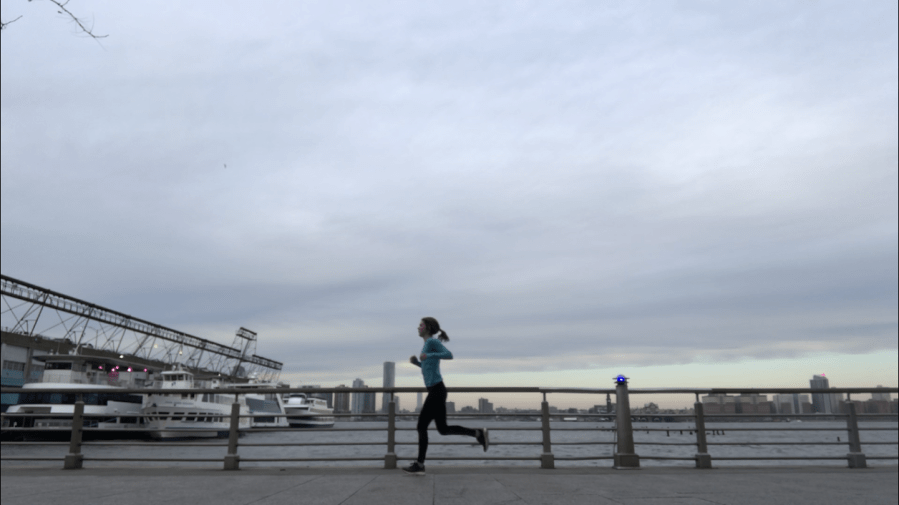
    6:30am — I wake up and have a glass of water and a ginger shot before my run. Everyone has the flu in New York right now, and I’m doing everything in my power to make sure my cold doesn’t turn into the flu. By 7am I’m out the door for a run. I have an easy 45-60 minute run scheduled for today, so I run 6 miles at a comfortable 8:30 pace, and finish with some striders and stretches.

    8:30am — I have a jar of overnight oats for breakfast that I made last night since I’m in a bit of a rush to head to class. Since I’ve reached a point in my training where I’m running more miles than my non-training norm, I feel like I’m hungry all the time, so I add a big scoop of coconut butter to my oatmeal to keep me full until lunch time. I also have a concoction of hot water, lemon, apple cider vinegar, and marine collagen that I make every morning before breakfast. I don’t like coffee, so this is my version of the drink that makes me feel set to start the day.

    9am — Off to class! This semester, I’m working on my creative thesis, which consists of me writing a Sex Ed curriculum that is far more concerned with students’ emotional well being than simple biology instruction, and I have to give a presentation on my project this morning. I grab a bottle of Pressed Juicery Green Juice No. 5 from my fridge (a splurge… they were having a sale!) to sip on throughout the day.

    IMG_2234

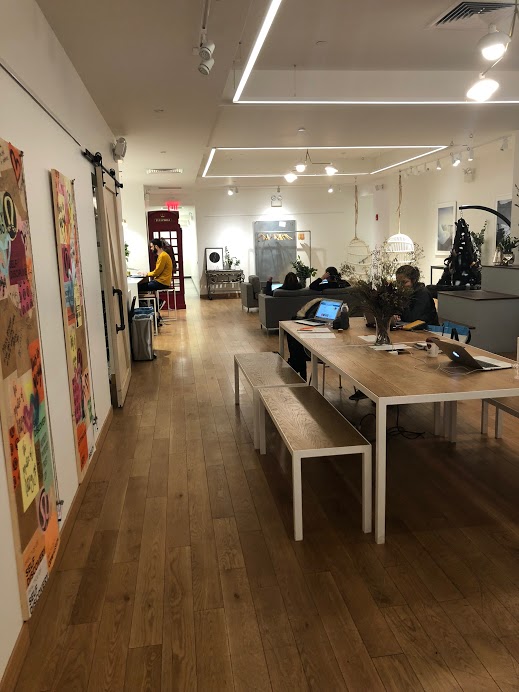
    11am — I don’t have class again until dinnertime tonight, and I find the library at school extremely sad, so I’m always on the hunt for places to work that don’t require me to purchase $7 matcha lattes. A friend and I head to Hub Seventeen, a free workspace in the Flatiron lululemon store to get some work done.

    12:30 PM — Lunchtime!

    IMG_2233

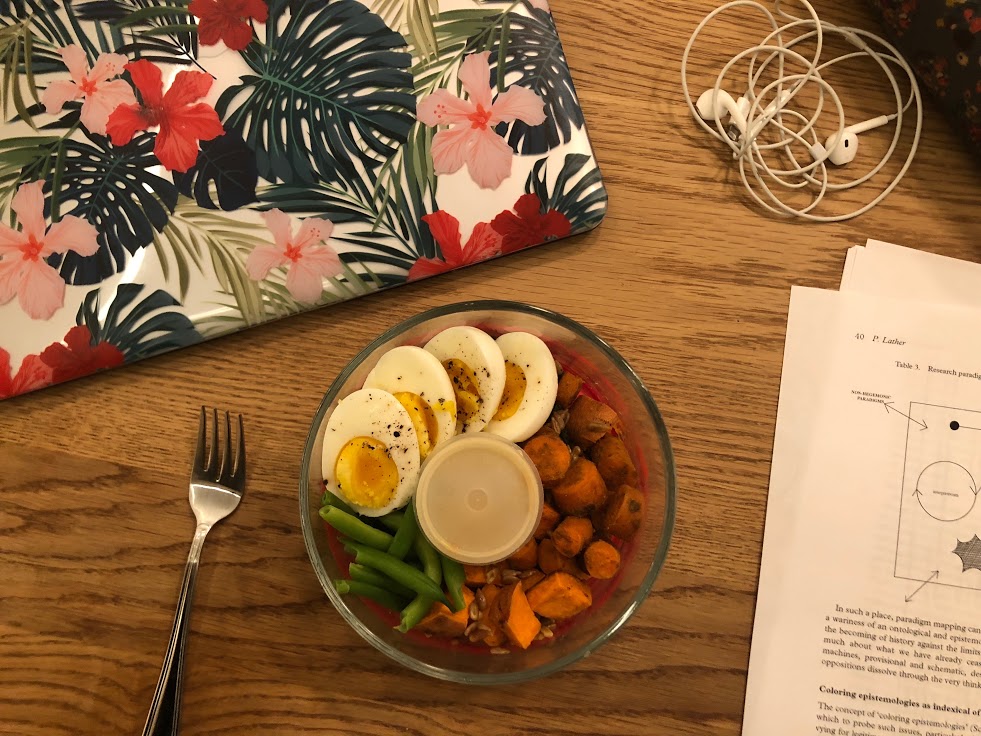
    One of the best parts of working at a space that isn’t a café is that I can bring my own lunch, too. Using food that I meal prepped yesterday, I packed a bowl of steamed kale and green beans, roasted sweet potatoes and carrots, hard boiled eggs, sunflower seeds, and a peanut dressing that I made. I’m in general quite a healthy eater (I’m one of those lucky humans who loves vegetables), but I haven’t always had the healthiest relationship with food, so I try not to adhere to any specific diet too closely to avoid too much rigidity. That said, it’s easiest to describe me as a pescetarian. I do a fair amount of meal prep each weekend too, which helps keep me fueled and saves me a ton of money. I like to think carrying around my lunch and dinner tupperware counts as strength training too… 🙂

    1:30pm — I pop up a block to Athleta to exchange a pair of running leggings for a different size. They have the best return policy… even though I bought these leggings a month ago, they let me exchange them no questions asked for not only a different size, but a pair with better pockets!

    3:30pm — After a very productive afternoon, I walk home, have a snack, and do some more reading. I’m trying to take advantage of my last semester of college and the days when I have a little more flexibility in my schedule, so I curl up in bed for an hour with Bird by Bird, a great book on writing that I’m reading for a creative writing seminar, and a mug of vegan yogurt, granola (if you haven’t tried Purely Elizabeth’s Chocolate Sea Salt + Peanut Butter Granola, you haven’t yet lived… it’s that good), and blueberries. I do a little stretching and spend some time on my foam roller too, which is a bit of a challenge in my apartment as I seem to always knock something over, but my calves appreciate my efforts.

    6pm— Back to school! My creative writing seminar goes from 6:30 to 9, so I bring my dinner with me to eat midway through class. It’s not all that different from lunch, but still tastes pretty darn good. I try to change it up a little, though, and have a bowl of quinoa, kale, green beans, carrots, turmeric tofu, peanut sauce, and sunflower seeds.

    9:15pm — Today feels like it’s been a long one. I make myself a mug of peppermint tea, lather a rice cake with peanut butter and add some banana, and do a little more work for school.

    10:15pm— I’ve started putting technology away between 10 and 10:30 so that I can properly wind down before I go to sleep. It’s tough to get myself to do it, because lying in bed and scrolling through Instagram can be rather tempting, but I’ve been sleeping so much better. I also diffuse lavender essential oil in my room at night, which makes the whole going to bed thing extra calming. My lights are out by 11.

    Total Miles: 6 Continue reading “The Runner Diaries — Willa Tellekson-Flash”

    4 Fitness Classes To Try In November

    As a health and fitness editor, I am routinely contacted by PR gurus and studio owners about trying out various new classes, workouts, gyms and training studios throughout New York City. While I love experimenting with and trying new workouts, far too often I show up at a studio only to realize that the “media” class is simply a shorter, condensed version of the actual workout. And other times I realize that I just hate the workout and would never try it again on my own.

    In a world where drop-in class rates cost upwards of $30, I want to help you figure out what’s worth spending your hard-earned money on (and prevent wasting your money on a class you absolutely detest).

    Here’s a review of all of the new gyms and workouts I tried out in October, so you can get the scoop before trying them out yourself.

    The Training Lab

    IMG_1582

    Where: 28 West 37th Street, 2nd Floor | Chelsea Continue reading “4 Fitness Classes To Try In November”

    The Runner Diaries — Mark Kennedy

    Inspired by Refinery29’s Money Diaries and The Cut’s Sex Diaries, welcome to The Runner Diaries, where we’re sharing a behind-the-scenes look into a week of training with runners of varying ages, paces and GPS coordinates.

    This week, we have Mark Kennedy of Toronto, Ontario — a 43-year-old businessman, father and leader of Strava’s None to Run Challenge, who knows the best way to celebrate a run well done is with a pint of beer.

    The Rundown

    Name: Mark Kennedy
    Location: Toronto, Ontario, Canada
    Age: 43
    Training For: N/A
    Occupation: Chief Compliance Officer, I also blog/podcast for fun.
    Goal race? N/A (but and signed up for a 13km trail race in September and am contemplating a half marathon in October)
    Following a training plan? No
    Part of any running communities, clubs or training programs? I lead and participate in the None to Run Challenge on Strava
    How long you’ve been ‘a runner:’ 24 years. Played many sports growing up, but got into running my first year of university.
    Goal weekly mileage: N/A

    Runner’s Statement

    At the moment, I am not training for a specific race, nor distance. I grew up playing many different sports, with a focus on basketball, baseball and track. I never considered myself a great long distance runner and, actually, as a youngster, was a better sprinter and jumper. Continue reading “The Runner Diaries — Mark Kennedy”

    Breakfast Tacos and 800s in Austin

    Like many runners, my favorite way to explore a new city, town, or area is by running through and/or around it. Not only do I feel like I’m able to experience more sights, scenes, trails and roads than I would be able to view from a car window, but I also feel more in tune and connected with the place itself, and the people — most notably, the fellow runners, walkers and cyclists — I encounter along the way.

    Over the summer, I woke up early to run to the piers of Pismo Beach and watch surfers catch waves while the rest of the bachelorette party I was traveling with slept in. In September, I got to run the ski trails of Park City (while breathing heavily, of course). And most recently in October, I got to run through the streets of Lakewood — Colorado which also proved challenging, but was a welcome change from the heavily crowded and busy streets of the city that I’m used to.

    That’s probably why the activity I anticipated most when visiting Austin, Texas, this past weekend was a leisurely jog on the running and bike path along the Colorado River. And unlike in California, I didn’t have to do it alone.

    fullsizerender-4 Continue reading “Breakfast Tacos and 800s in Austin”