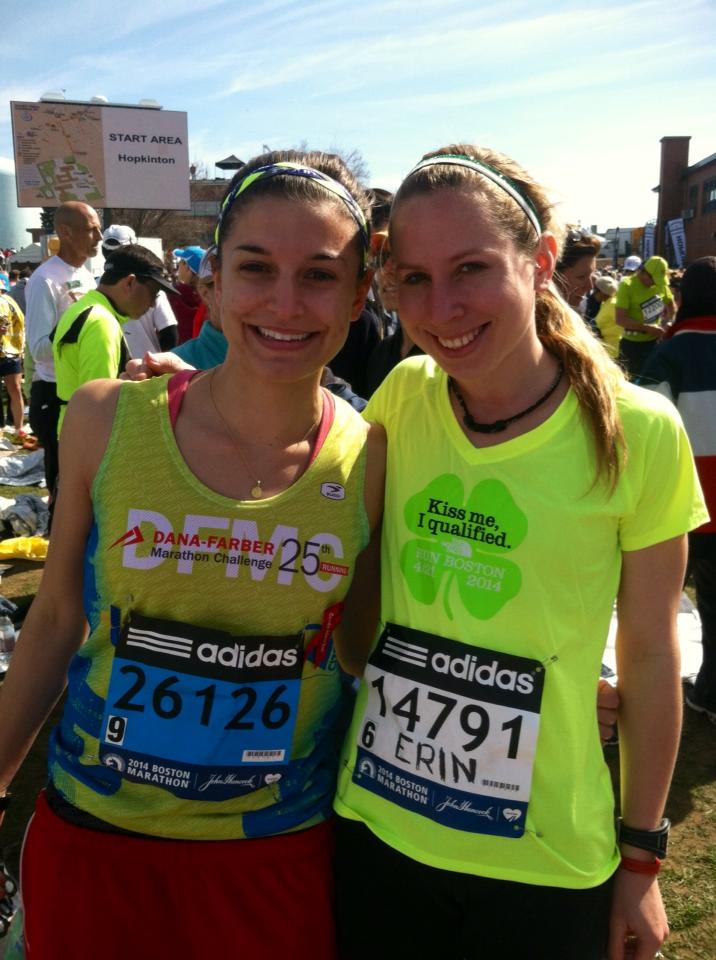
As most of you know, I’ve been training for the Boston Marathon coming up on April 16. It’s the first time I’ve taken my marathon training seriously in a long time, and it’s been quite a haul. Luckily, I have been working with a great coach, Christopher Baker. Even though I’m a run coach and hold many others accountable, I find it really hard to hold myself accountable when I’m planning for so many other people, so it’s helpful to have someone taking the guesswork out of my training. While the workouts have been quite grueling — and balancing them with everything else I have going on in life (work, school, coaching, attempting to have a social life) has been even more demanding — I’m happy to have a schedule and some kind of consistency in my life.
As a tune up, I ran the Sleepy Hollow Half Marathon on Saturday. It was a wonderful opportunity to see some real-time results of this training plan in action. A friend had suggested the race after the drawing results for the New York City Half came out, and while I didn’t have any desire to run another NYRR race, I liked the idea of a small town race in a new and different place. While the hills of the course were intimidating, I liked that there was no pressure to PR, and the idea of getting a race in before the marathon.
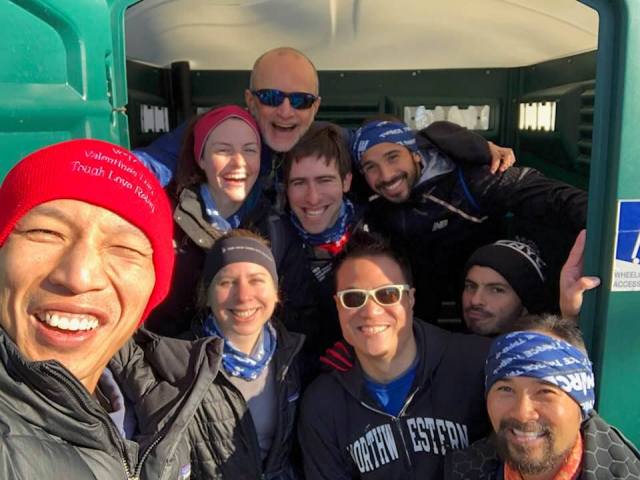
A few friends from The Most Informal Running Club, Ever (NYC), and I headed up to Sleepy Hollow via the MetroNorth train, and were able to walk to the race start from the train. The weather was chilly, but sunny, so it was nice to not freeze our butts off before the race like the runners in the NYC Half had done the weekend before. We even had time for our tradition of taking a photo in the Port-A-Potty (don’t ask why).
Welcome to The Runner Diaries, where we’re sharing a behind-the-scenes look into a week of training with runners of varying ages, paces and GPS coordinates. Get The Runner Diaries delivered to your inbox, here.
This week, we’re following 41-year-old Edith Zuschmann of Klagenfurt, Austria, a lifelong runner who has been lucky enough to turn her passion into her profession. The sports journalist and run coach is also the global CEO of261 Fearless, an international women’s running network she co-founded with women’s running pioneer Kathrine Switzer. Zuschmann runs to find peace and freedom, and to provide herself with a healthy work-life balance.
THE RUNDOWN
Location: I live in Klagenfurt, Austria but travel half the year for work. This week I am in Boston Age: 41 Training For: My life! Running is my passion Occupation: CEO 261 Fearless Inc. & Sports Journalist Goal race? I want to do some Swim/Runs and Mountain Races in 2018 Following a training plan? No Part of any running communities, clubs or training programs? 261 Fearless How long you’ve been ‘a runner? Since I was a teenage Goal weekly mileage: No specific number – right now, it’s just about staying fit!
Author Edith Zuschmann (left) and Katherine Switzer (right)
Runner’s statement: “Do what you love – and love what you do!”
Thursday – Day One
6am: As a running coach, I tell my athletes to not only run, but also to concentrate on core work. So, to practice what I preach, the first thing I do today is a 30 minute CORE program. All I need is my yoga mat.
6:45am: After a quick shower, I enjoy a high protein breakfast — porridge with yoghurt, nuts and fresh fruits. I take my time because breakfast is my most important meal. I also drink some Italian coffee — that’s my luxury as I just live 40 minutes from the Italian border.
8:30am: My working day begins, which is full of writing, Skype meetings, and calls. Mostly it is about 261 Fearless (pronounced ‘TWO-SIX-ONE Fearless‘), a global social running network for women. Our main mission is to use running as a vehicle to empower and unite women globally through the creation of local running clubs, educational opportunities, a global communication platform and special events. By utilizing these networking opportunities, 261 Fearless breaks down the barriers of geography and creates a global community for women runners of all abilities to support each other and encourage a healthy lifestyle, a positive sense of self, and fearlessness. I established this non-profit organization in 2016 with women’s running pioneer Kathrine Switzer.
Today we have to work on setting up our 2018 Boston Marathon Charity Team and work on several inquiries about our international 261 Club network. I also need to prepare for my trips to Boston and New York City.
Noon: Lunch time! It’s fall – and pumpkins are everywhere. Homemade Pumpkin soup is easy to prepare and so healthy.
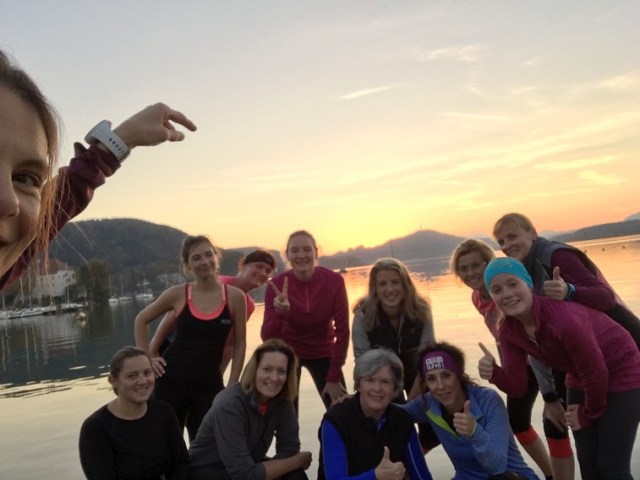
6pm: I meet up with my 261 Club ladies for our weekly, one hour social run. 261 Clubs are the core of 261 Fearless, as these local organizations provide weekly runs for women and support them through their journey of finding, and keeping, the joy of running. The main goal is to provide a non-performance driven, judgmental-free running community.
Today we warm up with an easy jog. After 1k, we stop to do some strength training: push ups, steps, dips, and balance exercises.
Our running route continues along the beach. We laugh and chat together, keeping a relaxed pace so we can all enjoy the run together.
7:30pm: I jog back home, snag a quick shower, down a glass of hot chocolate, and start packing my suitcase.
One evening in late October, I was catching up with a friend when I suddenly found myself breaking down.
“I’m going through a hard time,” I told her, choking back tears. “I had the worst summer of my life.”
The first statement was true, evidenced by my zombie-like daytime interactions and random, tear-filled outbursts on the subway (sorry, New Yorkers on the A train). But I’ll admit that the second was pure melodrama, sputtered only in retaliation to how the event I had most been looking forward to all summer had played out: my first Ironman.
Starting in May and continuing through September, I dedicated weekday mornings and full weekends to swimming, biking, and running to prepare for the 140.2-mile course of Ironman Maryland on October 1. I’ve run 10 marathons before, but I approached my training to this particular race with a new level of determination. I hired a triathlon coach, found a core group of training partners, and even upgraded my steel-framed bike to a triathlon-specific, carbon-fiber model from Specialized bikes.
I was dedicated. And come October, I was ready to crush the distance.
Unfortunately, the Ironman gods had other plans. On the morning of the race, the swim start was first delayed, then abruptly cancelled due to unsafe water conditions. We were left with only the bike and run portions of the course. While not insignificant feats, it was not the race course we had expected.
Crossing the finish line of my first Ironman-sanctioned race should have spurred feelings of elation, victory, and pride for pushing through a difficult challenge despite unfortunate circumstances (not to mention terrible weather conditions). But I didn’t feel any of those things. Instead, all I could feel was an overwhelming, crushing sensation of sadness and the scary prospect of the unknown.
If you’ve run a race recently, you might recognize these phrases from the signs held by spectators along the course. Crowd support is an incredible phenomenon, and as a longtime runner, I’m forever grateful to anyone who comes out and stands on the side of the road, rain or shine, for hours, just to watch me run by for 10 seconds.
But as much as I appreciate giving a swift high five to a, “Touch here for power” sign (it really does make me feel like I’ve just had a gulp of Space Jam’s secret stuff!), I get equally as frustrated with some spectators and their not-so-helpful cheers. For example, the guy who yelled, “You’re almost there!” to me at mile 11 of the 26.2-mile Boston Marathon this year made me want to fling myself off the side of the road.
I was fuming: Was this guy seriously watching this race without any idea how long a marathon is?! Did he not understand how far I still had to run?! My mood shifted from concentrating on the course before me (did you know marathons hurt?) to being furious with a stranger. It was depleting, and in a way, demeaning—though I know that wasn’t his intention.
The fact of the matter is: Sometimes fans think they’re being helpful, but their “motivating” cheers or race signs are actually mentally draining and deflating for runners. To help fans be the best support crew they can be, I polled my friends in The Most Informal Running Club Ever, NYC to see what they most enjoy hearing or seeing during a race.
Here are the best (and worst) things to say or do on the sidelines.
Ways to Be Helpful
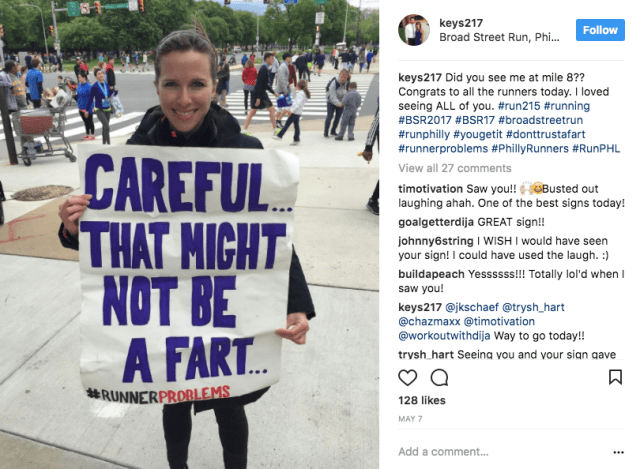
“I laugh at signs that say, ‘Don’t trust a fart.’” — Christopher Ho, marathoner
“During the Boston Marathon, I laughed out loud, pointed, and gave a thumbs up to the guy holding a sign that said, ‘If Jeb! can make it through 2015, then you can make it through this race.’” — Michele Richinick, two-time marathoner
“I love signs that say, ‘You’re faster than [fill in mass transit of choice]—like, ‘You’re faster than the G train’ (New York), or ‘the metro’ (Washington, DC), or ‘the T’ (Boston).” — Jasmin Roman, marathoner
If you are signed up for the 2017 New York City Marathon, you probably know that you need to start training fairly soon, if you haven’t already started. If you don’t, well, here’s your heads up: it’s time to start running!
The marathon is an entirely different beast of a race than a local 5k or 10k — or even a half marathon. So when it comes to tackling the 26.2-mile distance, it’s not uncommon to question whether or not you need to hire a running coach to get yourself to the finish line.
I’ll be the first person to tell you that you probably don’t.
That’s right — Road Runners Club of America Certification and all, I’ll tell you right now that you don’t need a coach to get yourself to the end of a marathon course. In fact, if you’re in decent enough shape, you could probably walk or jog the course to completion right now.
However, having said that, if you did attempt to conquer the course right now, it would most likely be a horrible experience. It wouldn’t be enjoyable, and you’d probably suffer through it — maybe even injuring yourself along the way.
That’s why I’ll be the first person to tell you that you don’t need a coach to get yourself through a marathon … but it’s a pretty good idea.
Having a running coach or mentor to guide you through 18, or 16, or 12 weeks of marathon training is helpful for a number of reasons, whether you’re a novice runner or a seasoned athlete. While I didn’t hire a coach for my first marathon, I sought out the guidance of coach Chris Baker for my first ironman and am confident that my experience was infinitely better because of it.
How, exactly, can a run coach help get you to the finish line? Let me count the ways.
Inspired by Refinery29’s Money Diaries and The Cut’s Sex Diaries, welcome to The Runner Diaries, where we’re sharing a behind-the-scenes look into a week of training with runners of varying ages, paces and GPS coordinates.
This week, we have Lorna Chaulet, a 25-year-old from Boston, Massachusetts. Despite Chaulet’s claim that she is anything BUT a runner, below, she documents her week running back-to-back marathons in Paris and Boston.
The RUN DOWN:
Name: Lorna Chaulet Location: Boston, Mass Age: 25 Training For: Paris & Boston Marathons Occupation: Marketing at Reebok Goal race? Paris Marathon Following a training plan? No Part of any running communities, clubs or training programs? I’m a member of Janji Corps How long you’ve been ‘a runner:’ 2016 Goal weekly mileage: One long run per week Continue reading “The Runner Diaries — Lorna Chaulet”→
Inspired by Refinery29’s Money Diaries and The Cut’s Sex Diaries, welcome to The Runner Diaries, where we’re sharing a behind-the-scenes look into a week of training with runners of varying ages, paces and GPS coordinates.
This week, we have Christopher Baker of New York’s Upper East Side. Baker is an artist, endurance sport coach, and active member of running and triathlon community The Battalion. Below, he documents his training to achieve an aggressive goal of qualifying for the 2018 Boston Marathon (“BQ-ing”) in the upcoming New Jersey Marathon, and a trip to the northeast to spectate and cheer at the Boston Marathon on Marathon Monday.
The Run Down
Name: Christopher Baker Location: Upper East Side of NYC Age: 39 Training For: New Jersey Marathon on April 30, and Ironman Chattanooga on September 24 Occupation: Artist Goal: BQ (under 3 hours, 10 minutes) at the NJ Marathon Training Plan? Yes, I personally designed it. It is an aggressive 6-week plan due to when I decided I wanted a BQ attempt, and when the race fell. I run 20 to 25 miles a week on average when not training for a race, so I already had a solid base to start. Part of any running clubs? I am part of The Battalion, a local running/triathlon team. How long have you been a runner? I have been running for 9 years. Goal weekly mileage? My goal mileage this week is 30-40 miles.Continue reading “The Runner Diaries — Christopher Baker”→
It is with a heavy heart that I write this blog post — the post where I “announce” that I won’t be running the Boston Marathon this year.
There, I said it. And honestly, it actually wasn’t that hard to say. But the thought process, and events, that have brought me to this conclusion, have been anything but easy.Continue reading “On Boston”→
Inspired by Refinery29’s Money Diaries and The Cut’s Sex Diaries, welcome to The Runner Diaries, where we’re sharing a behind-the-scenes look into a week of training with runners of varying ages, paces and GPS coordinates.
This week, we have Brittany Lewis, a 28-year-old Upper East Sider juggling a vigorous PhD program with training for her first Boston Marathon.
Lewis with her sister
THE RUN DOWN
Name: Brittany Lewis Location: New York, NY Age: 28 Training For: Boston Marathon Occupation: Student Goal race? Boston Marathon Following a training plan? Yes, loosely following a generic plan I poached from the Internet ages ago) Part of any running communities, clubs or training programs? The Most Informal Running Club, Ever (TMIRCE) NYC, and November Project NYC How long you’ve been ‘a runner:’ Since 2013 Goal weekly mileage: 35-40 miles
Let me start this post by saying that I am incredibly lucky.
I have a wonderful, supportive family and am overwhelmed on a daily basis by the amount of phenomenal friends I can count on in my life. I have two, strong legs that can carry me through what seems like an insane amount of miles to many people. I am not terrible looking. I have a great job, smart coworkers, and a cozy apartment in Hell’s Kitchen with a roommate who is nice and asks me about my day when I come home.







 Run From Your Problems