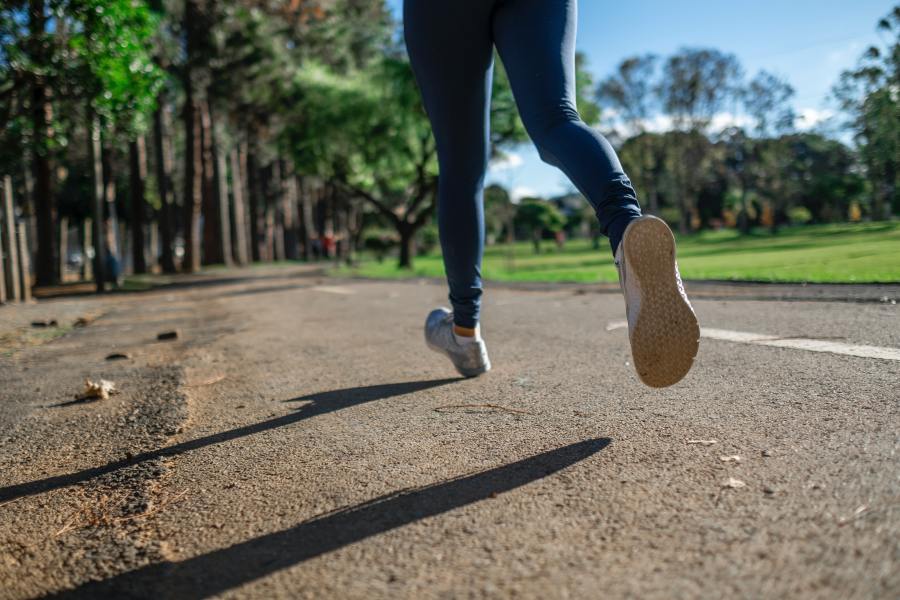
Running On Your Period? 3 Takeaways for Balancing Your Menstrual Cycle with Your Marathon Preparation

The other day I got a panicked text from one of my athletes. Her period tracking app had just informed her that her period was set to begin on the DAY of her first marathon. As someone who experiences cramps, bloating and gastrointestinal distress leading up to and during the first 48 hours of her period, she was worried about how it would impact her first-ever marathon. 

“What advice do you have for running on your period?” she asked. 

While I’ve spent time figuring out how to navigate my own menstrual cycle and distance running, I know that everyone who menstruates experiences their own signs and symptoms that may not be applicable to the next person. So I decided to look into the research available on menstruation and marathon performance, as well as poll my trusted running community via Twitter and Instagram. 


When it comes to running on your period, here are the three biggest takeaways I discovered throughout my search. 

1. Getting Your Period During A Marathon Might Actually Help You Perform Better

There’s limited research surrounding the topic of female marathon performance and menstruation. However, there is evidence to suggest that running on your period may actually improve your performance. 

A 2021 study published in the International Journal of Sports Physiology and Performance administered a survey questionnaire to recreational, non-elite runners who had completed multiple marathons within the past 18 months. Of the 185 women found eligible for the study, a total of 106 had their best marathon performance in the luteal phase of their menstrual cycle, when female sex steroid hormones estrogen and progestin are high. Seventy-nine had their best performance during the follicular phase, when estrogen and progestin are low. 

For those unfamiliar, the luteal phase begins right after ovulation and lasts about 14 days, ending just before a menstrual period occurs. The follicular phase, or the phase in which your body prepares to release an egg, begins after the luteal phase (days 14 through 21) and starts on the first day of menstruation. Therefore, the study’s results found that women are more likely to perform better either just before, or actually during, their period.

Why does this happen? Well, research shows that female sex steroid hormones (SSH) are more than just reproductive hormones. They also affect metabolism, bone health, respiration, muscle function, thermoregulation, and fluid balance. Compared to exercise, elevations in the SSH during the menstrual cycle at ovulation and during the luteal phase cause lower blood lactate responses, increased fat oxidation, and reduced glycogen utilization during exercises. All of these physiological effects can potentially be advantageous for exercise performance — particularly for endurance activities, like running a marathon.

While it’s important to recognize that this is an observational study — AKA it is based on reports from individuals themselves and not performed inside a lab — other research and anecdotal evidence confirms this phenomenon. Stacy Sim’s book ROAR, includes both anecdotal and research-backed evidence of athletes experiencing peak performance during their cycle.

2. You Can Incorporate Your Menstrual Cycle Into Training

Just because research suggests you may perform better when on your period, doesn’t mean your cramps, gastrointestinal issues, bloat and other symptoms associated with your period won’t get in the way of, or affect, your goal race. While research suggests exercise during your period may actually reduce symptoms like cramps, that may not hold true for everyone. Additionally, heavy menstrual bleeding (HMB) during your period can potentially put you at risk for low iron levels, which can cause fatigue, anxiety, reduced mood and energy levels, certainly affecting your ability to perform. 

That’s why it’s important to incorporate your menstrual cycle into your training. Log the start and end of your period into your training log, as well as any associated symptoms that accompany it. This way, you can track what helps relieve your symptoms (Midol, increased hydration, iron supplements, specialized nutrition) and have a better knowledge of what to expect if, in fact, your period does arrive the week of your race.

It’s also important to log a long run and a hard tempo interval (or speedwork) while on your period. Knowing how your body reacts to stress from your period can help you adequately prepare and push through difficult moments during the race.

3. There Are Other Ways to Prepare

Just about every runner who menstruates has experienced their period on a run, so fortunately there is a lot of anecdotal evidence about what works for different runners. Suggestions include taking Midol, investing in period panties (Thinx even makes a special ‘sporty’ period panty) or a diva cup, opting for a dark-colored race day bottom in case of leaking, waking up early enough to allow for period-related digestive issues to unfold naturally, keeping some toilet paper with your GUs in case the Port-A-Potty runs out, and if you’re on birth control, skipping an off week to move things up a week and avoid getting your period on race day altogether. However, this last suggestion could backfire due to stress, so I don’t personally recommend it. 

You can also look for information on your marathon’s official website to see if their med tents will offer sanitary supplies like tampons or pads. If unavailable, email the official race contact to ask.

***

While you can prepare for your period, the truth is, there’s still much to be learned about how they affect our performance. Additional research performed on how the menstrual cycle affects marathon performance has found that even elite athletes and their coaches understand very little about the menstrual cycle.

While we wait for more research to become available, the best thing you can do is track how your period affects your running performance to gain valuable information to help you ace your next race.

Image by Daniel Reche via Pexels

Is Running Bad for Your Knees?

Originally published at https://finishlinept.com/team-finish-line/runningmyth-knees/

Whether you’ve been running for 10 years or 10 days, you’ve likely gotten this question when disclosing your healthy habit: “But isn’t running BAD for your knees?” It can be hard to argue with individuals who’ve been listening to anti-running propaganda for their entire lives, but fortunately there’s plenty of research to disprove this myth.

Although running certainly puts stress on your joints — it’s a single limb hopping activity, after all — multiple studies have found that recreational running is not associated with an increased risk of knee osteoarthritis. In fact, multiple studies, including a 2021 systematic review and meta-analysis (AKA, a study that synthesizes data from a wide variety of other studies) found that running can actually be advantageous for your knees. By loading the knee joint during running, researchers believe you’re actually helping to facilitate nutrition penetrating into the cartilage of your knees while simultaneously squeezing out metabolic substances, like water. Since cartilage assists the movement between your bones, as well as absorbs shock and transfers load through your bones to reduce friction, this is an act of service for your joints that can actually help protect them. 

While this particular review did find that running has a short-term adverse effect on cartilage oligomeric matrix protein (COMP), a biomarker (or indicator) of osteoarthritis, this increase was only temporary, with levels returning to normal within 1 hour. No adverse effects were found on knee cartilage volume or thickness, which are both often affected by OA.

Although the 2021 systematic review was pretty conclusive (researchers combined and synthesized results from two randomized controlled trials and 13 cohort studies), other research exists to back up its results. A 2017 cross-sectional study taking into account 2637 community adults found no increased risk of knee osteoarthritis among self-selected runners compared to non-runners. Other studies have found that not only is running not harmful for individuals with osteoarthritis, but it can even be beneficial: A 2019 cohort study from the Osteoarthritis Initiative that analyzed over 1,000 adults over 50 with knee osteoarthritis found that not only was running not associated with longitudinal worsening of knee pain or structure degradation, but running also helped reduce pain in individuals with knee osteoarthritis. 

Of course, some individuals will experience knee pain throughout the course of their running career, as the knee is the most commonly injured body part in runners. But these injuries — including patellofemoral pain syndrome (PFPS), iliotibial band friction syndrome (ITBFS), and patellar tendinopathy (PT) — are often due to overuse, muscular imbalances and weaknesses, and faulty biomechanics. Not only can these injuries typically be treated in an outpatient orthopedic physical therapy setting, but they’re also reversible. 

This evidence may seem confusing, and it’s normal to wonder how exactly a runner’s knees can withstand so much loading, so often. Some researchers think that in addition to providing nutrition to your joints and keeping cartilage healthy, your cartilage also goes through changes to keep up with your running habit. A study from 2020 suggests that medial knee cartilage likely adapts in runners as they age in order to withstand a lifetime of running — proving that runner’s knees aren’t “bad,” they’re just resilient. 

How Long Should You Taper Before A Marathon? Here’s What the Research Says

After months of intense marathon training, it can feel counterintuitive to slow your roll in the last few weeks before your race. But that’s exactly what a taper is: An opportunity to tone down your training, reduce your mileage and intensity, and let your body really absorb the months of hard work you’ve put in — while simultaneously resting in order to regroup your full strength and energy by race day.

For some runners, the taper is a dream. A chance to rest after a physically and mentally demanding couple of months?! Bring it on! 

However, a lot of the runners I coach absolutely HATE the taper. Even though it’s designed with optimal race performance in mind, it disrupts the routine they’ve so diligently followed for the past several months, and can even make them feel lazy. Many of my runners report feeling sluggish rather than rested. And for some of my female athletes especially, this less intense volume of mileage worries them that if they don’t pay close attention to their nutrition, they’ll have a few extra pounds to cart around with them on race day.

This leads to a lot of athletes “kind of” (but not really) tapering, or asking me to keep their taper short and sweet (just two weeks).

Despite the apprehension about the taper, research shows that a longer, more disciplined taper may improve marathon performance.

A study published in Frontiers in Sport and Active Living analyzed the training activities of more than 158,000 recreational marathon runners to define tapers based on a decrease in training volume (or weekly mileage). 

Researchers found that strict tapers were associated with better mathon performance compared to relaxed tapers, and that longer tapers (up to three weeks) were associated with better performance when compared to shorter tapers. In fact, a strict three-week taper was associated with a median finish-time saving of 5 minutes and 30s, or 2.6%, when compared to a shorter taper.

These study results are similar to previous research on the subject, and suggest that recreational runners can improve their marathon performance by adopting a longer, more regimented taper.


The bottom line? The dreaded taper might just be your ticket to a new PR. Embrace it!


Smyth B, Lawlor A. Longer Disciplined Tapers Improve Marathon Performance for Recreational Runners. Front Sports Act Living. 2021;3:735220. Published 2021 Sep 28. doi:10.3389/fspor.2021.735220

Does weather really dictate running performance?

It’s marathon season! Which means everyone with a race on the calendar is fixated on one thing, and one thing only: The weather.

That’s right. Out of all the things you can and can’t control on race day, obsessively checking and rechecking the weather seems to be a runner’s favorite past-time. As a running coach, I’ve heard all sorts of theories on “the best weather for running,” ranging from cold-weather enthusiasts to those who thrive off sunny skies. But it made me wonder: what’s actually the best weather for running a marathon?

A 2020 study published in Medicine & Science in Sports and Exercise analyzed meteorological data for 1258 races — from the marathon, to the 50k, to the 5k and the 3000m steeplechase — held between 1936 and 2019 across 42 countries, enabling analysis of 7867 athletes. Through machine learning, it concludes that a Wet-Bulb Globe Temperature of between 10 and 17.5 degrees Celicus — or 50-63.5 degrees Fahrenheit — increased the likelihood for peak performance. For every degree outside these optimum conditions, performance declined by 0.3-0.4 percent.

A different study published more recently in Frontiers of Physiology analyzed data from the Berlin Marathon results over the last 45 years, and found that temperatures greater than 15 degrees Celsius (59 degrees Fahrenheit) and higher precipitation levels impaired performance of master marathoners.


So, what’s the moral of the story? While you can’t guarantee a perfect weather day, if your heart is set on a PR, you can schedule your next race strategically. Pick a marathon in a specific location and at a specific time of year to increase your chances of waking up to good weather. While you’ll probably still obsess over your weather app in the weeks before the big day, at least now you can do so with a little more science on your side.

Running In The Heat Can Make You A Stronger Runner. Here’s How To Do It Right.

For runners, summer means more than weekend getaways and trips to the beach—it’s also synonymous with fall marathon training. Odds are, if you’re planning on running one of America’s iconic fall road races, like the New York City Marathon, the Chicago Marathon, or even the Philadelphia Marathon, you’re going to be running through some pretty hot weather. 

Now that I live on the West Coast, temperatures are way more ideal for summer running, but even I’m not immune from the effects of the sun. Additionally, summer travel—whether I’m going back to the east coast or just an hour or two away—exposes me to a far wider range of elements. 

Running in the heat can be difficult, and even more strenuous for certain people. But here’s why you shouldn’t immediately dismiss hot weather runs: Studies have found that running in the heat won’t just increase your rate of perspiration (which is helpful for cooling down your body), but it can also increase an athlete’s blood plasma volume, which leads to better cardiovascular fitness. Training in the heat can also reduce overall core temperature, reduce blood lactate, increase skeletal muscle force, and even increase your training capabilities in colder temperatures.

That’s right—some experts support the claim that heat acclimation can actually be more beneficial than altitude training when it comes to positive physiological adaptations. Santiago Lorenzo, a professor of physiology at Lake Erie College of Osteopathic Medicine and former decathlete at the University of Oregon, told Outside Magazine that he believes heat acclimation provides “more substantial environmental specific improvements in aerobic performance than altitude training,” citing the fact that heat training does a better job at increasing VO2 max than altitude, and also makes athletes better at dealing with a wider range of temperatures. 

However, the benefits of training in elevated temperatures doesn’t change the fact that summer running can get us all hot and bothered. So many things can go wrong, from pesky annoyances like chafing, to more dangerous outcomes like heat stroke. To help you stay hydrated and happy during your long runs this summer, here are my top 10 tips for hot weather runs. Continue reading “Running In The Heat Can Make You A Stronger Runner. Here’s How To Do It Right.”

The Runner Diaries — Allie Kieffer

Welcome to The Runner Diaries, where we’re sharing a behind-the-scenes look into a week of training with runners of varying ages, paces and GPS coordinates. Get The Runner Diaries delivered to your inbox, here

This week, we have 30-year-old Allie Kieffer, a professional runner for Oiselle who placed fifth in the 2017 New York City Marathon. Kieffer is currently training in Iten, Kenya to prepare for the United NYC Half and the London Marathon. Follow along as she logs roughly 115 miles while living like a local.

The Run Down

Name: Allie Kieffer
Location: Iten, Kenya
Age: 30
Training for: NYC Half Marathon, London Marathon
Team or Club Affiliation? Oiselle & New York Athletic Club
How long you’ve been a “runner:” Forever! I joined my first running club when I was in kindergarten 🙂
Weekly mileage: 115

Runner’s Statement

I’ve been training in Iten, Kenya for the past 6 weeks to prepare for the NYC Half Marathon and London Marathon. In the past I’ve done altitude stints in Boulder, Colorado and Flagstaff, Arizona. I’ve always really enjoyed the mountains lifestyle and have responded well to the heightened elevation, so when the opportunity arose in January to train at altitude in a distance running mecca with a warm climate, I couldn’t pass it up!

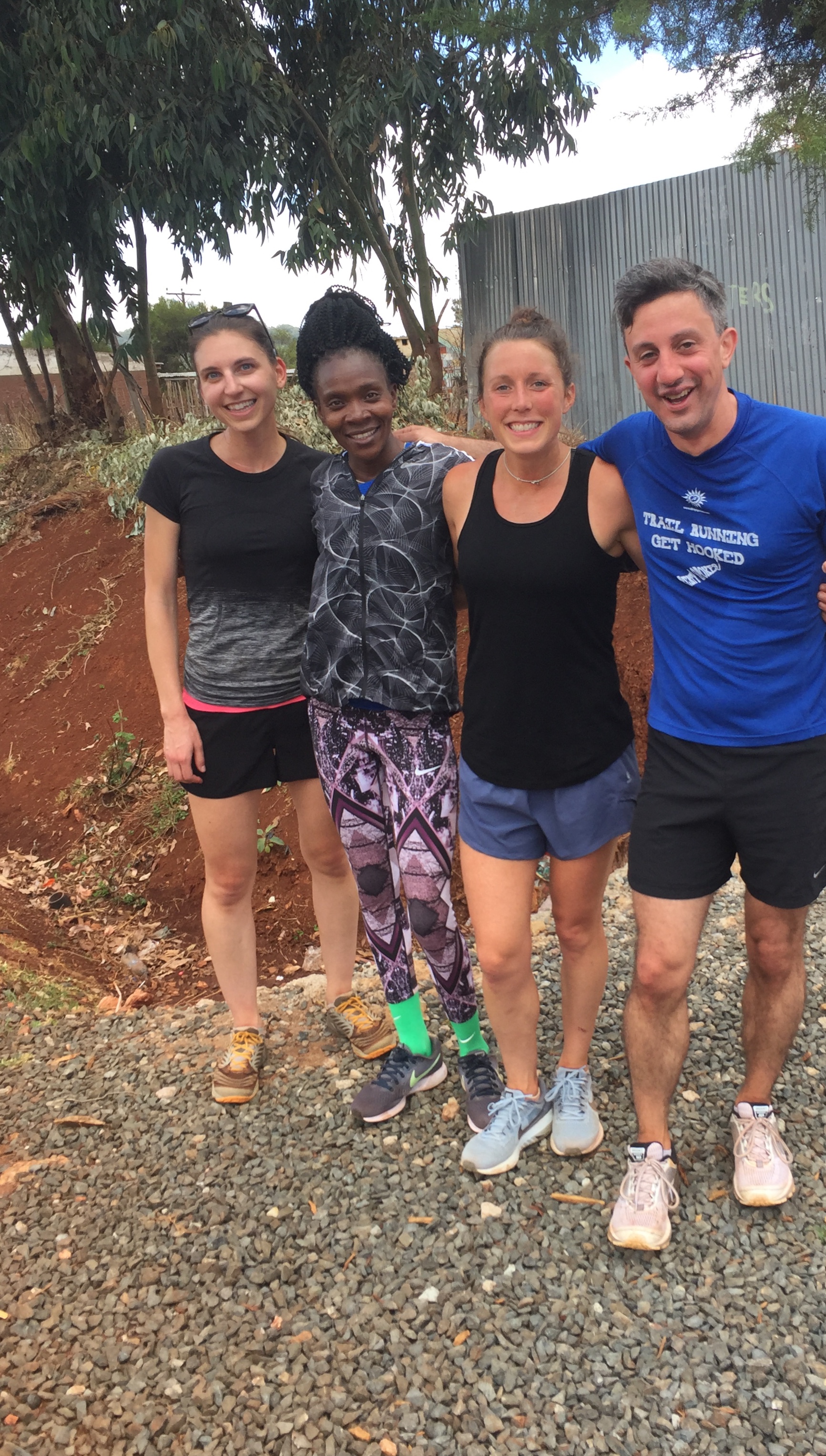
After racing the Ooredoo Half Marathon in Doha, Qatar January 12th I got on a plane for my first trip to Africa! Since landing in Kenya, Betsy Saina and I have become fast friends- she has helped me set up an apartment, find a pacer (someone who does all of my runs with me), and figure out life in another country. Each week has gotten better than the last and I am excited to share with you my final week in Iten before returning to the US!

Saturday Feb 24th | Day One

5:40AM – woke up before the alarm! I make some shroom coffee and took advantage that it was only 9:40PM home in NY to call some loved ones!

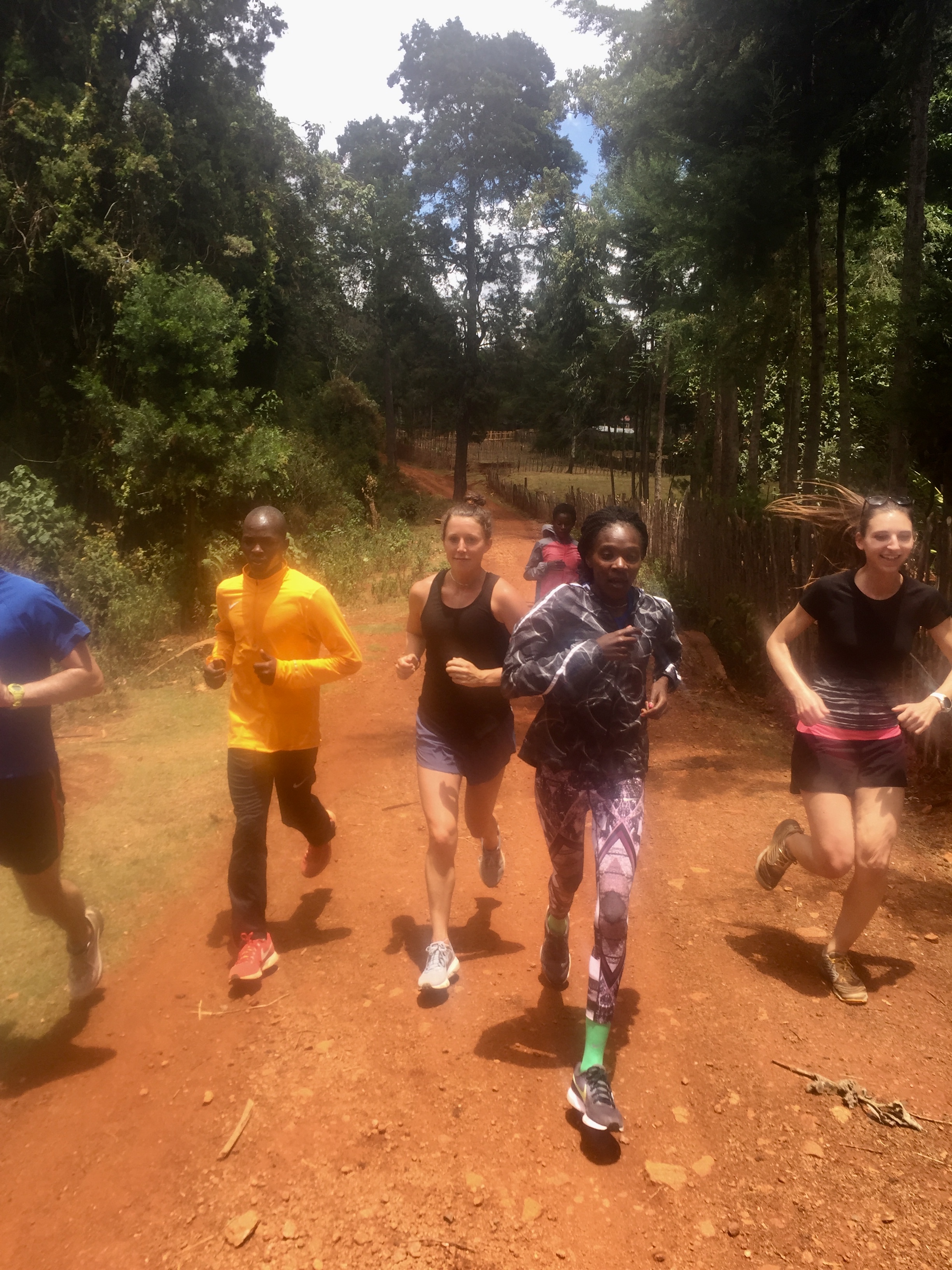
6:10AM – head out the door with Chelsea (a friend from college that came to visit me in Kenya!) to meet Julia (a Canadian I recently met and have become friends with) and Dickson (my pacer). Usually we travel down to a lower altitude and flatter road for a fast, supported long run. As the sun comes up, matatus (vans for hire) follow groups of gazelle-like striders, handing out bottles of water and whatever super nutrition is packed inside. I have been sick for the past few days, though, and didn’t know how far I’d make it, so this week we ran from my apartment at 7,800ft to Kipsang Rd (named after Wilson Kipsang because he owns a nightclub on it).

image2 (1)

There’s no matatu today, and how far we’ll all go is a mystery; it’s only Chelsea’s second day in Kenya! I immediately feel awful and we shuffle for a few warm up miles. After 3K we meet the gang, plus a new friend, Edward, who is Dickson’s neighbor. After a mile he lets it slip that he won the Marugame Half Marathon in 60 minutes earlier this month.

Then, he zips off, putting distance between us like we’re standing still. I start to warm up and we click off 7:10-7:20’s for the next few miles. The rolling hills remind me of Magnolia Rd in Boulder, Colorado.

image3 (1)

At 10 miles we turn around, and I pick up the pace a bit and distance myself from the group. Just as I was starting to feel really strong I ran into Edward again. To my surprise, he turned and ran with me. We immediately drop the pace. There’s like an inherent thought with Kenyan men that they should pace and push the women. For the next 8 miles I hung on as best I could as he kept looking back to make sure he wasn’t dropping me.

After 20 miles I was back at the paved road and 3K from home. I decided to catch a motor bike back home with Chelsea and be happy making it through 20 miles!

Watch data: 20 miles in 2:24:20. Elevation gain: 1,128ft

9AM – arrive home to a buffet of omelette, pancakes, and tea!

11:30AM – Chelsea and I walk through the local market. Every Saturday locals set up shops and sell their goods in a field by the center of town.

1:30PM – head home for green grams and rice! We are so spoiled!

3:30PM – second run! I don’t usually double after a long run, but I missed a couple of doubles during the week because I was sick. I take Chelsea through my favorite route in the Singore forest.

Watch data: 4.83miles in 41:23 (avg page: 8:34). Elevation gain: 341ft

5:30PM – Julia comes over to hangout with Chelsea and I!

6:30PM – YouTube interview with Greg White (watch it here).

7:30PM – dinner – chapati (a slightly sweet, thick and airy tortilla-like African staple. it’s typically dipped in stew, but it tastes great plain too), kale, lentil, butternut squash soup, and my favorite fruit salad of banana, mango, pineapple, and avocado.

It’s not typical in Kenya to have dessert, but fruit salad is a great, healthy alternative. I believe in eating a diet rich in whole foods and a minimal amount of processed foods. In the US, I don’t usually eat very many simple carbs like bread and opt for something like a sweet potato instead, but in Kenya I eat like a local.

10:30PM – full belly and lights out!

Total daily mileage: 25 miles! Continue reading “The Runner Diaries — Allie Kieffer”

Here’s Why You Might Feel Sad After Finishing a Marathon

[originally published in March 2017]

One evening in late October, I was catching up with a friend when I suddenly found myself breaking down.

“I’m going through a hard time,” I told her, choking back tears. “I had the worst summer of my life.”

The first statement was true, evidenced by my zombie-like daytime interactions and random, tear-filled outbursts on the subway (sorry, New Yorkers on the A train). But I’ll admit that the second was pure melodrama, sputtered only in retaliation to how the event I had most been looking forward to all summer had played out: my first Ironman.

Starting in May and continuing through September, I dedicated weekday mornings and full weekends to swimming, biking, and running to prepare for the 140.2-mile course of Ironman Maryland on October 1. I’ve run 10 marathons before, but I approached my training to this particular race with a new level of determination. I hired a triathlon coach, found a core group of training partners, and even upgraded my steel-framed bike to a triathlon-specific, carbon-fiber model from Specialized bikes.

I was dedicated. And come October, I was ready to crush the distance.

Unfortunately, the Ironman gods had other plans. On the morning of the race, the swim start was first delayed, then abruptly cancelled due to unsafe water conditions. We were left with only the bike and run portions of the course. While not insignificant feats, it was not the race course we had expected.

Crossing the finish line of my first Ironman-sanctioned race should have spurred feelings of elation, victory, and pride for pushing through a difficult challenge despite unfortunate circumstances (not to mention terrible weather conditions). But I didn’t feel any of those things. Instead, all I could feel was an overwhelming, crushing sensation of sadness and the scary prospect of the unknown.

Now what? Continue reading “Here’s Why You Might Feel Sad After Finishing a Marathon”

Inspiring Words From MEB Before The Marathon

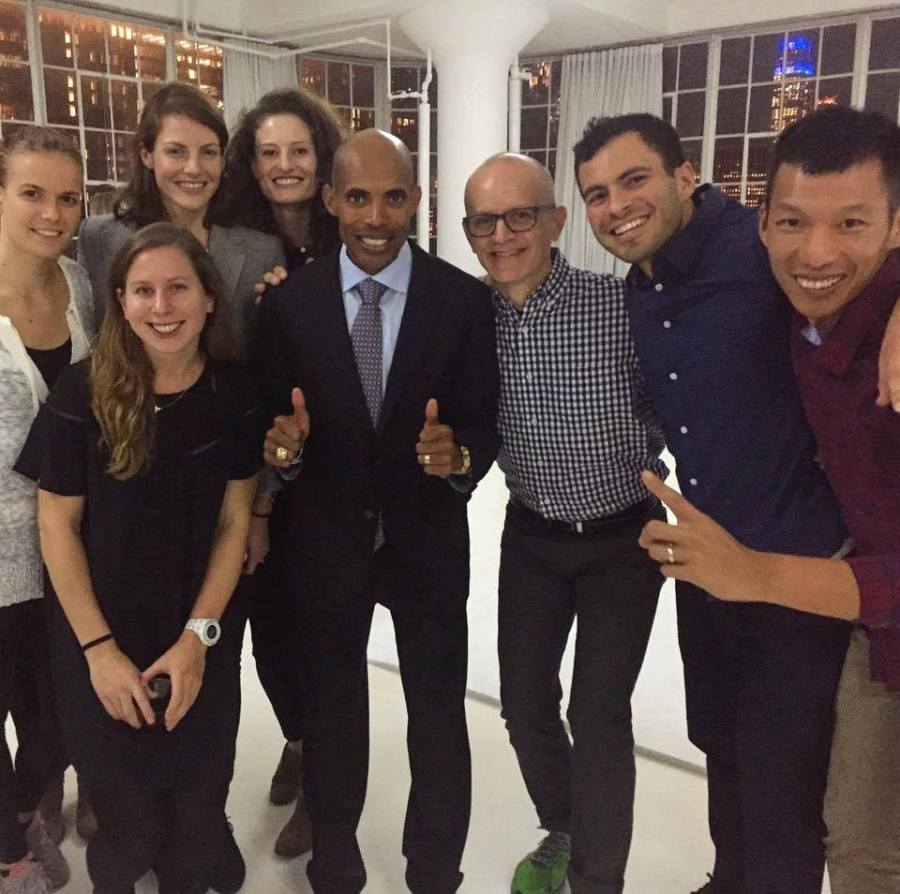
The New York City Marathon is this Sunday, which means New York City is buzzing with excitement (and I’m sure, a LOT of pre-race jitters). What’s even better is that a lot of elite runners are in town to celebrate the days leading up to the big race, including Meb Keflezighi, who will be running his 26th (and final) marathon this Sunday. I’ve had the honor of meeting with the American athlete, Olympian and 2014 Boston Marathon winner in the past, but took special pride in listening to what he had to say in front of a packed room at Custom Performance Physical Therapy Wednesday evening, and at his retirement party at Jack Studios in partnership with Epson on Thursday night.

On Wednesday, Meb had a Q&A-style interview with Gary Muhrcke, the winner of New York City’s first marathon in 1970 (he ran a 2:31:39), Keflezighi. At Epson, a similar format with a different host ensued. He answered questions about his own training as well as dished out advice to fellow runners in attendance. As always, I was awed by Meb’s fun-loving attitude and humble demeanor — especially right before such a big race!

Here are the biggest takeaways from the event.

The Swag IS Worth It

Perhaps my favorite story that Meb told us was that he came to learn he had a self-described God-given talent because he was bribed with a t-shirt. His seventh grade physical education teacher promised anyone in the class who ran a 6:15-minute or less mile would get a free t-shirt, and an A in the class. I smiled at this story, and think that a LOT of runners can relate. We all do some pretty questionable things for swag.

Preparation Is The Key To Success

It’s not what you do in two hours of practice, but what you do to care for yourself in the next 22 hours,” Meb explained, emphasizing the importance of recovery. “Do things diligently, day in and day out.”

Meb Didn’t Begin Running Marathons Until He Was 27

As a recent 28-year-old, this gives me hope that my running journey is just beginning.

Encourage More People To Join The Sport

Meb encouraged everyone in attendance to invite others to join the sport of running.  “We always remember who brought us to the sport,” he explained. “Encourage others to join you.

Take Comfort In The Crowd

Meb draws inspiration from other runners as he races. “My mantra? I know I’m hurting. That person next to me must be hurting as well. I want it it to hurt more.”

The Ideal Pre-Race Dinner? Spaghetti & Meatballs

At least, that’s what Meb’s mom used to make him before big races when he was growing up.

It’s OK (and Normal) To Fail Before You Succeed

“So many people I know or have read about failed many times on the road to becoming the best they could be. It’s not how many times you fall, it’s how many times you get back up.”

POST-RACE UPDATE

Meb finished 11th at Sunday’s Race in 2 hours, 15 minutes, 29 seconds. He may not have made his goal to be in the top 10, but he certainly gave New Yorkers an inspiring victory lap.


The Best and Worst Things to Say to a Runner During a Race

“Go, random stranger!”

“If Donald Trump can run, so can you!”

“Worst parade ever.”

If you’ve run a race recently, you might recognize these phrases from the signs held by spectators along the course. Crowd support is an incredible phenomenon, and as a longtime runner, I’m forever grateful to anyone who comes out and stands on the side of the road, rain or shine, for hours, just to watch me run by for 10 seconds.

But as much as I appreciate giving a swift high five to a, “Touch here for power” sign (it really does make me feel like I’ve just had a gulp of Space Jam’s secret stuff!), I get equally as frustrated with some spectators and their not-so-helpful cheers. For example, the guy who yelled, “You’re almost there!” to me at mile 11 of the 26.2-mile Boston Marathon this year made me want to fling myself off the side of the road.

I was fuming: Was this guy seriously watching this race without any idea how long a marathon is?! Did he not understand how far I still had to run?! My mood shifted from concentrating on the course before me (did you know marathons hurt?) to being furious with a stranger. It was depleting, and in a way, demeaning—though I know that wasn’t his intention.

The fact of the matter is: Sometimes fans think they’re being helpful, but their “motivating” cheers or race signs are actually mentally draining and deflating for runners. To help fans be the best support crew they can be, I polled my friends in The Most Informal Running Club Ever, NYC to see what they most enjoy hearing or seeing during a race.

Here are the best (and worst) things to say or do on the sidelines.

Ways to Be Helpful

Screen Shot 2017-11-01 at 1.35.38 PM

“I laugh at signs that say, ‘Don’t trust a fart.’” — Christopher Ho, marathoner

“During the Boston Marathon, I laughed out loud, pointed, and gave a thumbs up to the guy holding a sign that said, ‘If Jeb! can make it through 2015, then you can make it through this race.’” — Michele Richinick, two-time marathoner

“I love signs that say, ‘You’re faster than [fill in mass transit of choice]—like, ‘You’re faster than the G train’ (New York), or ‘the metro’ (Washington, DC), or ‘the T’ (Boston).” — Jasmin Roman, marathoner

Continue reading “The Best and Worst Things to Say to a Runner During a Race”

Here’s Everything You Need To Pack For Marathon Village This Sunday

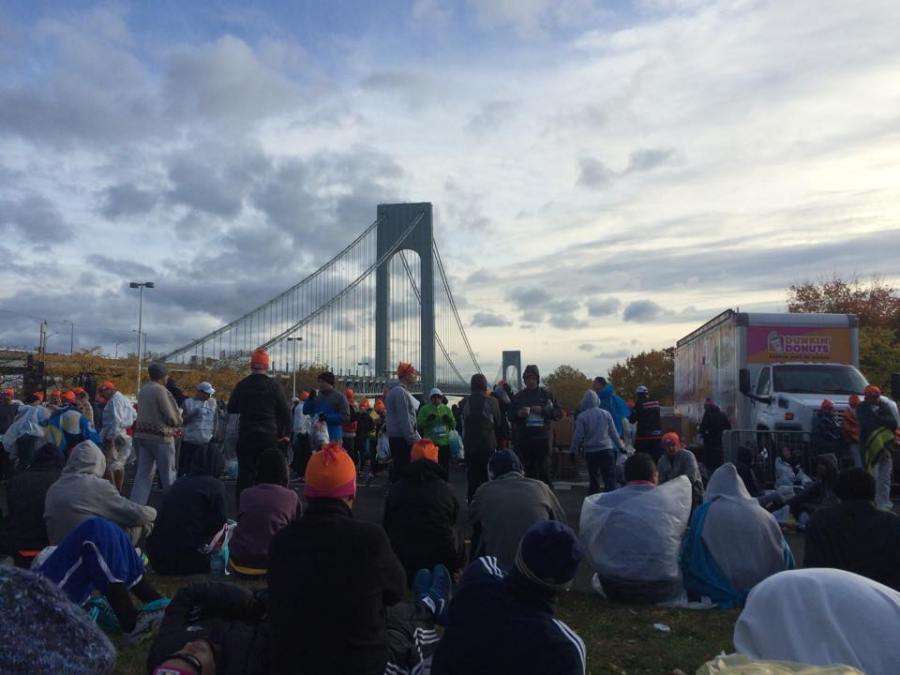
The New York City Marathon is a unique race from start to finish, and one of the things that truly sets it apart from other races is the marathon village where runners congregate before heading to their respective corrals. I’ve run New York City twice in the past, so have spent at least six hours in the marathon village on Staten Island — maybe even longer! The first year, I was pretty shocked at the vast differences between this pre-race situation and others. The security is heightened, which means it takes a little bit longer to get there, and you’re stuck waiting in a (very large) contained area for an extended time period. So it pays to be prepared!

Below, please find a list of suggested items to pack for marathon village. Note that these items are separate from your actual race-day outfit (including SPI-belt and any running accessories!) and fuel for the race.

    1. Throwaway layers. Even if you think you won’t need them, bring them. You can get cheap sweatshirts and/or sweatpants at a local Thrift Store, or take the opportunity to clean out your closet and find warm clothes you don’t wear anymore.
    2. A blanket. Even if you don’t think you’ll be cold, you’ll be waiting for awhile. You may want a blanket to snuggle under, or even sit on.
    3. Toilet paper/wet wipes. While the Port-A-Potty situation is typically plentiful, you never know what might happen once you’re inside. Be prepared.
    4. Plastic ziplock bags for your phone in case it’s wet.
    5. Extra food & water. You’ll be waiting a long enough that you’ll probably need to eat. Bring food, snacks, and water/gatorade.
    6. Clear garbage bags. These can be used for warmth (yes, you can wear a garbage bag!) or as something to sit on. The ground will most likely be wet upon arrival.
    7. Extra socks. These can double as hand warmers pre-race.
    8. Extra sunscreen. It may be November, but you’ll likely be outside during the sun’s strongest hour. Grease up!
    9. Bodyglide. If you love it, lube  it.
    10. Handwarmers. It probably won’t be that cold, but if you tend to get chilly easily, might as well bring a pair.
    11. OPTIONAL: A cheap, portable phone charger. Marathon village gets terrible service and will eat your battery alive. If you plan on having your phone with you post-race for pictures, getting in touch with friends, etc., a cheap portable phone charger can at least ensure you’ll start the race with a decently full battery. You can choose to hand off your charger to a friend or family member spectating the race, or leave it in marathon village to be donated. **Either way, I highly recommend keeping your phone on AIRPLANE MODE in marathon village to avoid burning out your battery**

10406859_10154812426745352_8893709993161483386_n

Other things to remember:

  1. Lay your race day outfit out the night before and share it with your friends and family members so they know what you’ll be wearing. This also helps you have a smooth and coordinated marathon morning.
  2. If you’re planning to meet up with friends inside marathon village, try to meet them at the ferry or bus beforehand.
  3. Trim your toenails the night before the race.
  4. Write your name on your bib or shirt — it will be so helpful to have strangers calling out your name!
  5. Charge your phone, GPS watch, and iPod (if you use one) the night before the race.
  6. Pick a post-race meeting spot for friends and family spectating before Sunday. If you aren’t checking a bag, ask that someone hold a spare change of clothes and a body wipe for you.

Do you have anything to add? What are your “must-have” items in marathon village?